California Department of Transportation | United States
Gazex, DaisyBell | Since 1989- NO EXPLOSIVES
- 77 GAZEX/GAZFLEX
- 1 DAISYBELL
- ROADS/HIGHWAYS

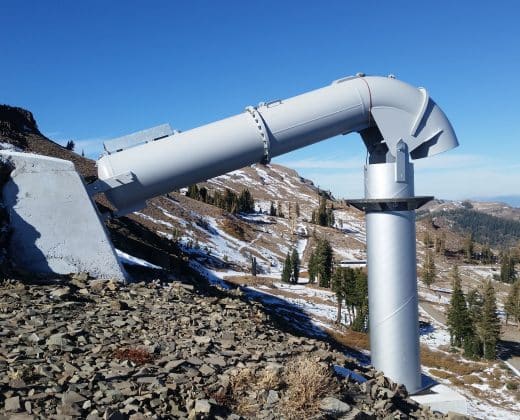
Since the early 1990s, the California Department of Transportation, Caltrans, has used GAZEX systems to manage avalanche hazard on several mountain highways in the Sierra Nevada. More than three decades of operation now provide valuable lessons not only about the technology itself, but also about maintenance, team organization and avalanche mitigation strategy.
Avalanche mitigation on California highways began in the early 1950s on Highway 50 at Echo Summit, before expanding notably to State Route 88. For many years, Caltrans relied heavily on hand charges and 75 mm recoilless rifles.
Artillery made it possible to reach avalanche starting zones from a distance, but the ageing military ammunition supply and increasingly common dud rates gradually became a major constraint. By the early 1990s, Caltrans was therefore looking for an alternative solution for avalanche control operations.
The arrival of remote avalanche control
The first Caltrans GAZEX systems were installed at Echo Summit in 1992, followed by Carson Spur in 1993 and Carson Pass in 1994. Other installations followed in the June Lake area. According to the experience presented at ISSW 2026, the network currently includes 53 GAZEX exploders in operation.
The principle significantly changed the organization of operations: exploders installed in avalanche starting zones can be operated remotely from a controlled location, without having to position a team or artillery system for each control mission.
Technology alone is not enough: the maintenance lesson
The early years nevertheless highlighted an essential point. Because triggering became easier, the systems were sometimes fired frequently while preventive maintenance remained insufficient. The Caltrans experience describes firing reliability of around 75% when Rob Bickor became involved with the program around 1999.
More structured annual maintenance, improved documentation and year-round dedicated avalanche personnel changed the situation. Caltrans now reports firing reliability above 99%, with more than 500 firings across all exploders in an average year.
The key lesson is clear: a remote avalanche control system is long-term infrastructure. Its performance depends as much on design and installation as on maintenance, skilled personnel and local knowledge of the terrain and snowpack.
From a reactive approach to more proactive mitigation
One of the most significant changes concerns when mitigation operations can be carried out. Conventional methods require more personnel and logistics, and can increase exposure to severe winter conditions. A fixed remotely operated system makes it easier to carry out mitigation when forecasting indicates that it is warranted.
At Carson Spur, all 16 GAZEX exploders can be fired in approximately 15 minutes. The road closure can still last several hours depending on avalanche results and the clean-up required, but the control phase itself has become significantly more efficient.
Two units added in 2017 also replaced operations that had previously required more than an hour of personnel access to specific areas.
GAZEX as part of a multi-tool strategy
The Caltrans experience also shows that no single technology covers every configuration. Depending on terrain and conditions, the teams continue to use different tools, including LoCat pneumatic systems, hand charges and, since winter 2023, a DaisyBell.
Exploder location, terrain geometry, snow accumulation and even changes in vegetation can influence the availability and relevance of a fixed system. Caltrans therefore emphasizes the need for a viable backup plan for every exploder and avalanche path.
More than 30 years of continuous evolution
Beyond avalanche triggering itself, GAZEX has helped change the organization of the Caltrans avalanche program. More emphasis is now placed on forecasting, preventive maintenance, planning, documentation and long-term equipment management.
Some installations remained in service for several decades. Most Carson Pass exploders operated for roughly 32 years before replacement in summer 2026. The Caltrans experience ultimately shows that technology delivers its full value when it is part of a long-term strategy combining field expertise, maintenance and the ability to adapt.
About this publication – Adapted from the paper “Looking Back – 30 Years of Impact: A Caltrans GAZEX RACS History”, by Ryan Marvin, MND Safety USA, presented at ISSW 2026.